


Ep 60: Rebuilding Enterprise IT for the AI Epoch with Former Avanade CIO Ronald White
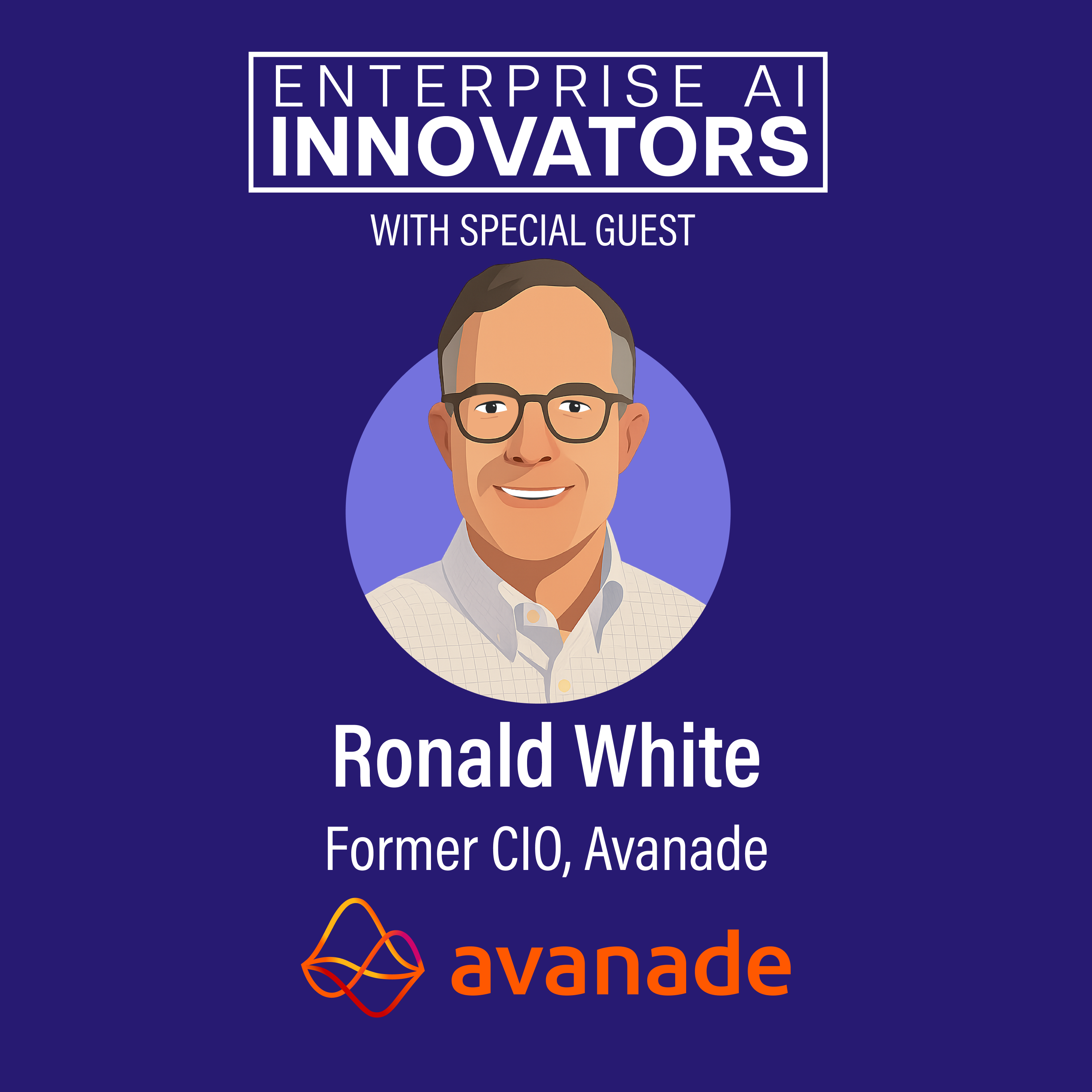
On the 60th episode of Enterprise AI Innovators, former Avanade CIO Ronald White joins the show to share how AI enabled a complete reset of enterprise IT operations, modernizing legacy systems and delivering measurable business value.
On the 60th episode of Enterprise AI Innovators, hosts Evan Reiser (CEO and co-founder, Abnormal AI) and Saam Motamedi (Greylock Partners) speak to Ronald White, the former CIO of Avanade. Ronald brings deep experience leading global enterprise IT at Avanade and shares actionable lessons from orchestrating large‑scale AI adoption across business functions.
Quick hits from Ronald:
On moving beyond surface-level AI: "What are we going to get past these little parlor tricks and actually do something that impacts the enterprise?"
On proving value through AI adoption: "A lawyer using general AI technology will 100 percent of the time beat a lawyer who is not. Period. End of statement."
On early enterprise wins with AI: "You’re changing the game right away... and so if you don’t stay on top of it and iterate and iterate and iterate, you lose."
Recent Book Recommendation: Destiny of the Republic by Candice Millard
Episode Transcript
Evan Reiser: Hi there, and welcome to Enterprise AI Innovators, a show where top technology executives share how AI is transforming the enterprise. In each episode, guests uncover the real-world applications of AI for improving products and optimizing operations to redefine the customer experience. I'm Evan Reiser, the founder and CEO of Abnormal AI.
Saam Motamedi: And I'm Saam Motamedi, a general partner at Greylock Partners.
Evan: Today on the show, we're bringing you a conversation with Ron White, former Global Chief Information Officer of Avanade. Avanade is a $4.5 billion professional services firm with over 60,000 employees, focused on helping enterprises modernize their technology systems.
There are three interesting things that stood out to me in my conversation with Ron. First is that Ron believes that in the age of generative AI, any repetitive or frustrating task — like writing performance reviews or cleaning up your inbox — can be handed off to AI. His advice is simple: start with pain points and then automate from there.
Second, he's pushing IT leaders to rethink old models with an “agile by necessity” mindset for agent-based systems. Speed matters more than perfection. Teams learn faster by deploying early, testing quickly, and iterating often.
And finally, Ron described a future of work where AI doesn't just give answers, but assigns tasks. It's a continuous loop of experimentation between humans and machines, where collaboration drives progress.
Ron, maybe kick it off. Do you mind sharing a little bit with our audience about your background and what your role is today?
Ron White: Yeah. So, I grew up in the consulting industry, started with what was then Anderson Consulting a long time ago and became Accenture. And then I went off to do the corporate thing and was a corporate CIO for a few years, then came back to Avanade as the Microsoft giant started to reappear.
What we do is we do all the Microsoft services for Accenture. We're at about a $4.5 billion entity with about 60,000 employees, and I'm our global CIO. One of the things that's very unique about being the CIO of Avanade is we're expected to be the tip of the spear for everything that Microsoft does.
So, anything they want to experiment with, anything that is new, I get the opportunity to put in production as fast as I possibly can. Some of it works, some of it doesn't, which is a challenge in and of itself. And then, you know, the hardest part for me is to really understand the broader market.
We like to think that we're way ahead because, especially in this space and in generative AI, Microsoft's pretty well positioned. But it's always a challenge to really make sure that we're in the best spot. And that's where our parents — we're a joint venture owned by Microsoft and Accenture — help us stay honest.
So Microsoft helps us stay honest to make sure that we're way ahead for them, and Accenture helps us stay honest in terms of, “Are you really differentiated in terms of what we're seeing across the broader technology landscape?”
Evan: You have a very unique role where you're simultaneously thinking about how to deploy technology inside your own organization, but also how you help your organization deploy new technology in customers’ organizations.
How does that unique perspective — working with so many third parties? How does that influence your thinking about how to deploy the best technology or get the best productivity inside the organization?
Ron White: Well, our job in a lot of ways is to be the best reference for our clients. So we go out there every day as a company, and we're working with our clients to implement solutions in the Microsoft ecosystem, which is very broad.
So when they say, “Okay, have you done this before? What does good look like?” the first place I want our sales folks to send them is to me and say, “I'll show you what good looks like. We've been doing this for a long time.”
The only problem we have at times is that our clients say, “Well, you're so far ahead of us. You've been doing this for so long, you don't even remember what it was like when you didn't have this kind of stuff,” especially when you talk about state and local government clients.
So that's the fun part, right — knowing that, and the scary part to an extent — knowing that our entire salesforce looks to us to be that reference one, as we call it, the best reference of how to do this and what good looks like.
Saam: You've been through many technology waves. Where are we in this wave, and where are we in the AI hype cycle?
Ron: I don't think we're as far as everybody thinks we are. You know, I think in this day and age, if you're in technology and you get asked questions — “Where are you on the AI spectrum? Are you using generative AI technologies?” — if you don't say yes, you essentially get fired.
And so in that environment, you have to say, “Yes, we're using it.” What we're seeing — and I run a lot of CIO forums and talk to peers, especially in the middle market — we are not necessarily Accenture, which handles a lot of the Fortune 500s, the massive enterprises. We handle a lot of the middle market, and so I'm talking to middle-market CIOs a lot.
A year ago, the big thing was their CEO coming to them and saying, “What's our AI strategy?” And they would say, “Oh, I'm going to have it, I'm going to have it.” And then they would go away and say, “I don't know what to do,” right?
We've evolved from that to: “Hey, okay, we have a general strategy around AI.” But one of the CIOs in one of the sessions said something I thought was absolutely fantastic. He said, “When are we going to get past these little parlor tricks and actually do something that impacts the enterprise in a substantial way?”
And I think that's where we're not as far as people think.
Saam: What are the two or three most common wins people have seen so far over the last 12 months?
Ron: I think the early wins I've heard from clients are when they enable — and what I talked about earlier — giving purview over a large language model to their enterprise data, and being able to kind of replace their legacy knowledge management capability with the ability to simply use a large language model over that enterprise dataset.
That is a huge win. Whether you do that with Copilot or a commensurate capability in the Google or Amazon world doesn't really matter. You're changing the game right away.
And I think the bar is moving so fast in terms of what you have to do. If you don't stay on top of it and iterate it and iterate it and iterate it, you lose.
I think the second thing is very siloed “parlor tricks,” if you will, of using this technology in individual functions in very pointed ways. I say siloed because they're not invasive, they're not broad, but they're impactful.
Everybody's going to have a small example of, “Hey, we did this thing, and it substantially moved the needle.” For us, it was about answering RFPs and analyzing whether or not an RFP was something that we were likely to win or lose, and making those qualifying discussions and decisions right away. That was a huge win for us — really small, very siloed, but very powerful.
Saam: How do companies get their employees to actually engage? And are there some hero use cases that you see the most forward-leaning employees do on top of something like Copilot?
Ron: The first step is to understand what the heck you're talking about from a user interface perspective. And again, this isn't the most exciting stuff, but really quickly:
At the beginning of the discussion over a year ago, we would talk about how important it is to begin to leverage these technologies so you have that opportunity to iterate, so you don't get behind. I'd use these examples, especially in the legal space — really powerful examples of analyzing redlines and all this kind of stuff.
And I would get these really weird looks because people had turned it on, and they would say, “I just don't understand. When you talk about doing some customization of these capabilities and giving it access to certain data and allowing it to do certain things…”
So when we talk to clients about that, the first thing is really an education. It's saying, “You say you're using certain things. Do you really understand what the impact and the implication can be?”
Evan: I was talking to a CIO the other week, and they're at this kind of, you know, not a high-tech company — it's an older company, it's been around for 200 years — and the CIO was kind of lamenting to me, “I'm really struggling to get the senior leadership on board with the AI stuff.”
What would be your top three quick wins to help get started?
Ron: I think the first one — and I'll give some specifics — but the first one is really drawing that analogous point to applications today, mobile apps.
The first thing I generally do when I hear, “Our leadership is not quite on board yet,” is say, “Okay, then tell them they're no longer allowed to use any mobile apps. Just say, ‘You can't do that anymore.’” That's essentially what you're doing, because we're going through the same cycle.
End users now are creating their own agents. Our biggest problem is not people using it, because they're using it — it's, as we talked about, governing it and controlling it.
Remember early on, and even today, with the app stores and all these things — think of the sophistication in the Apple Store, the Google Play Store, all these things, and you understanding: Is that a good app? Should I use that app? What is the personality of that app? How does it function? What data does it have access to?
This is where we are. So if you don't start now, that kind of stuff — that you would all agree you have to have — do you really want your users using agents that aren't secure, don't know what data they have access to, don't know what personalities they have? No, of course not.
So that's the first thing: if you say, “We're not quite sure,” you're basically saying, “You shouldn't be using applications on your mobile phone,” which of course you would never say.
Then I would go into: what are some of the low-hanging fruit, as you say? I mentioned earlier the legal side. Because the litigious world is so defined, large language models are really good at this kind of stuff.
It's not about eliminating my lawyers. I need as many lawyers as I had before. But a lawyer using generative AI technology will 100% of the time beat a lawyer who's not. Period. End of statement.
If you just take that conclusion and say, “It's so feasible to use it,” that means that your competitor — if you're not using it — is, and so you're going to lose.
So you focus on their competitive side and/or you draw this analogy to something that everybody uses every day. I think those two things have worked really well.
Evan: How has AI changed how you work personally? Are there things that have changed in your day-to-day workflow? And what are maybe two or three pro tips for me and Saam in terms of how we should be using AI?
Ron: Anything you hate doing — use it. Especially annual review time. Oh my gosh. Who likes writing those annual reviews that you have to do? Who likes organizing their email inbox? Who likes figuring out, when you come back from holiday, what the action items are?
Anything you hate to do, use it. And it will streamline that task and make it easier for you to do so you can focus on the things you love to do. That's kind of, to me, the first step. And it's all so feasible to do.
The other thing that's really important to understand — and this is where it gets a little scary, but at the same time it's powerful — is: think of it as a person. If it doesn't do the right thing for you, tell it and ask it. “I expected you to come back with this result, and you didn't.” That's how you'd speak to a human.
If I say something that's confusing to you, you'd say, “Ron, that's confusing to me. Can you explain it?”
All the time we get these beginners, if you will, coming back and saying, “Well, it didn't work.” “What do you mean it didn't work?” “It gave me the wrong answer.”
“Oh, so a human's never given you a wrong answer before? And that means you just don't talk to anybody who's ever given you a wrong answer?”
So making people think like that too is really, really important.
But I think, you know, we talked earlier about: is it truly embedded, is it really enhancing the business outcomes that we're achieving?
Personal productivity, efficiency — that's what's being done today. So if you're not gaining an effective productivity quotient, if you will, then you're already behind.
What you really need to start thinking about is those situations where — is every single accountant in your accounting department using it in a consistent way to drive the results they get every day? That's the question you need to ask.
And so you've expanded to every single employee. Every single employee should be using these tools every day to enhance their personal productivity and the outcomes they generate. And if you can't say that and know that, or don't have a plan to get there, then I would suggest you're already behind.
Evan: For maybe some CIOs that are listening, who maybe feel a little bit behind based on some of your past comments, what's one use case where you’d say, “Hey, I recommend every CIO should be doing at least this with AI every single week”? What would that be?
Ron: Enterprise search — finding things. You should never use traditional word-based enterprise search again. You should be using a large language model capability to help you find everything you need and analyze it.
So if you're an executive and your team sends you things to review, and you're not using a generative AI capability to review those documents and generate insights, then you should be.
Evan: How do you think these AI capabilities change the average knowledge worker’s work five years from now? How does the average employee’s life change? What is uncommon today that becomes very common in the average IT organization?
What are some of your predictions for where these technologies take us?
Ron: The thing I've heard recently, which is fascinating to me, is: if you think about how an R&D research analyst works, they don't really know where they're going. What they do know is where they want to get to.
And so the scientific method, if you will — you start to see a world where you're feeding an outcome you're trying to generate from these large language models, and they come back to you and say, “Well, I don't really know where I'm going with this, but if you could run these five experiments for me and come back with the answers, I will then take the next step.”
So it's this combination of human and large language model interaction. The large language model can't run the experiment — it's a physical experiment out in the ocean or something like that, or analyzing these specimens — and they don't really know what the answer is, and they can't really make conclusions until you feed back these experiments.
Then you feed back the results of those experiments, and it comes back and says, “Okay, I need you to refine these two, and then I'll come back with some conclusive results.”
Then you go back in the field. So you can think of this back-and-forth where it's not giving you answers, it's giving you tasks, and then you're coming back and giving it the results of those tasks, and it's extending the concept.
Evan: What's your contrarian take? What's a thing you think will be true in the future of AI that maybe most CIOs would disagree with, or most people would think is kind of science fiction?
Ron: I think we have to be honest with ourselves and say it is replacing jobs. It is replacing humans. And anybody that makes that argument that it's not, I'm not so sure really has sound footing to stand on.
So then what does that mean? My team asks me that all the time, which is, from a career progression perspective in the IT space, “What can I do in the age of AI to make myself relevant?”
Right now at least, you run through things that we still need — experienced people to run sophisticated programs, understand how to interact with executives, gather insightful perspectives, create, create, create.
So anything that is a commodity activity you need to look at as something you do not want to build a strength in.
I don't think the Terminator future is real. I tend to agree with a lot of really, really smart people saying this is not going to take over the world. But that does not mean — and none of them are saying — that we don't have a massive change in what it's going to take to be productive as a human.
That's the part I think we need to focus on. We've all heard those analogies of the big massive phone rooms of yesteryear, and yet those people have jobs now, and we're not full of those phone rooms.
So the same thing's going to happen. These jobs will be replaced and we'll create new ones. I think that gets a little, “I don't know what those new jobs are going to be.” That's what I want to focus on. That's what I want to tell people to think about: what can you do to be productive in this new world?
That's what I'm telling my kids. Programming, getting good at programming… I mean, come on. No. That's not what you want to be doing.
Evan: You've probably talked to more people on the planet about their AI roadmaps and what their plans are, and I'm sure you've seen some of those roadmap items come true or fall apart.
Are there any things that are red flags, where you see a project and you're like, “Look, I know that sounds sexy, but that's not the right place to start,” or “That's going to take you in the wrong direction”? Any kind of non-obvious traps you'd call out and maybe warn some of your peers about?
Ron: We tried agile in the corporate world, and what we had was a bunch of failures. Because you can't create a transaction system that generates an invoice in an agile way. It doesn't work that way, okay?
So it was one of those things where we were saying, “We're being agile,” but we're really not. We're really using waterfall methodologies that we've been using for years; we're just increasing how often we go to the end-user community to ask questions like, “Is this working the way we expected it?”
So it's iterative techniques as opposed to agile techniques.
I say that because generative AI is perfect for agile, because it never works right out of the box. It's always going to be inconsistent in its results.
So I go back to what Saam said from the very beginning: you have to get stuff out there fast, and you have to express to your end-user community two things. One, it won't work, but it's valuable. And two, here is the feedback mechanism and the commitment that we will be agile and improve its functionality very, very quickly.
So if you put something out there that doesn't work and then don't fix it, that's a huge problem. And yet that's not what our corporate IT departments are used to doing. They're used to putting things out there that work and then need to be enhanced. That is not what's happening right now.
What I find is my teams — I'm like, “Why isn't this out there? We had this commitment, this timeline. We're behind.” “Well, it's not quite working right.”
And what you realize is: it'll never work “right.” So you’ve got to have that discussion: “It'll never work right. So when is the right time to get it out there, get the feedback?”
And then they put it out there, and they're not ready for the feedback and they can't iterate. So all those things are really important.
Evan: So at the end of our episodes, we like to do a bit of a lightning round. We ask questions that are very difficult to answer in one tweet, but we're looking for kind of the one-tweet response. So please just forgive me and Saam in the future if these are a little bit unfair.
Saam, do you want to kick it off for us?
Saam: Yeah, absolutely. So Ron, maybe to start: how do you think companies should measure the success of a CIO in this AI era?
Ron: The number of employees that use AI technology — and how many times each day they do it.
Evan: So Ron, you have a bit of an unfair advantage because you see so many companies and you get a firsthand look at a lot of new technologies. Maybe for the average CIO, what do you recommend is the best way to stay up to date on the latest enterprise AI trends?
Ron: I think you’ve got to use your partners — your technology partners. Go out to Redmond, go out to San Francisco, visit Google. Go out there and make them show you their roadmap, what they're doing, what leading edge looks like, and ask really, really difficult questions like, “Well, that's interesting, but how do they do it? What's the impact going to be?”
I think rolling your sleeves up and getting your hands dirty is the best way to do it.
Saam: Maybe to switch gears to the more personal side: what's a book that you've read recently that had a big impact on you, and why?
Ron: Well, you know, it's funny — I'm a big history fan, and so I don't read a lot of technology-oriented stuff. But I think in history you can learn a lot.
I'm reading a book about James Garfield, the former president. He was this huge innovator when it came to farming techniques and some of the things that, at the time, were extremely important. And he was friends with all these inventors, the Edisons of the world and all that kind of stuff.
Innovation doesn't go away. Always asking yourself, “What can we do that's going to change the game? Be an innovator.”
You get lazy in this day and age, to a certain extent, thinking that the technology is going to solve all your problems. Some of the basic things you have to do as a leader — forcing yourself to innovate and forcing your teams to innovate — are still so important.
And just because they say they're using, as we've talked about over and over again, AI and generative AI technologies doesn't mean they're innovating.
Evan: What's an upcoming technology you're personally really excited about?
Ron: To me, what quantum computing can really do for society — what it can really do for our industries — becomes really interesting.
When you change the game and you're doing it right in this day and age, some of the things, from a data perspective, that took six to nine months a few years back can literally be done in ten minutes now. Literally. When you see that level of change, quantum should be able to deliver that level of change.
What does it mean to the industry? I think it's fascinating to explore what the quantum world looks like.
Saam: If you think really far ahead — 10, 20 years ahead — what do you think is going to be true about AI’s impact on the world that even those in the AI ecosystem would consider science fiction today?
Ron: I think it's not going to look as different as you think on the surface. I think a lot of people are going to be doing very similar things; they're just going to be doing it with the help of technology instead of humans.
You're still going to have farmers, right? But the yields will be to the point where we never could have imagined them. We're still going to have environmental issues, and we're going to have environmental scientists working on solving those issues, but their ability to make an impact is going to be an order of magnitude different.
So as much as we think about this massive change that we're going through, I think a lot of the jobs themselves will be the same. That's not super exciting, but I think — and maybe I'm just saying that to keep myself sane — I just can't imagine a restructuring of our society.
If you really want to go into it, maybe the world dynamic — politically, socially, everything — changes. I don't know. But I would like to believe that the good guys will win, and a lot of this is going to be helping us be better humans.
Evan: I appreciate you sharing, Ron. Thanks so much for making time. This has been a really fun episode, and I'm personally looking forward to talking more with you. Thank you so much for joining us.
Saam: Thanks a lot, Ron.
Ron: Yeah, my pleasure. Really fun talking to you guys.
Evan: That was Ron White, former Global Chief Information Officer at Avanade.
Saam: Thanks for listening to Enterprise AI Innovators. I'm Saam Motamedi, a general partner at Greylock Partners.
Evan: And I'm Evan Reiser, the founder and CEO of Abnormal AI. Please be sure to subscribe so you never miss an episode. Learn more about enterprise AI transformation on the Enterprise Software blog.
Saam: This show is produced by Josh Meer. See you next time.